The Economics Behind a Peptide Prescription, Explained

Last reviewed June 2026. Most of the compounds discussed here are compounded preparations or research chemicals, not FDA-approved finished drugs, and any prescription product requires a licensed clinician. Every clinical and cost figure below traces back to a primary source, linked in the references.
A peptide’s sticker price rarely reflects what a buyer is actually getting. Two people can pay wildly different amounts for what looks like the same molecule, and the gap between those prices is not marketing noise. It maps onto a small set of variables: how well the compound has been studied in humans, and how much clinical oversight sits between the vial and the person injecting it. This piece works through those variables in order, the way a reporter would work through a study, background first, then the evidence, then the caveats, then what a reasonable person should expect to pay.
Why the same peptide can carry ten different price tags
The word “peptide” covers a lot of ground. It includes molecules backed by large randomized trials and molecules backed almost entirely by animal data, and vendors have an incentive to let the credibility of the first group rub off on the second. A second pattern shows up just as often: a lower price usually signals that something protective, a clinician’s evaluation, a licensed pharmacy, batch testing, has been removed from the transaction rather than that a buyer found a bargain. A cheap “research” vial and a supervised prescription are not two versions of the same product. The difference between them is precisely the layer of oversight that keeps a buyer safe, and that layer costs money to maintain.
What the trials actually showed
Some peptides do have strong evidence behind them. Semaglutide and tirzepatide are both peptides, and both have been tested in large randomized trials. In the STEP 1 trial, adults taking semaglutide 2.4 mg once weekly lost a mean of 14.9% of body weight at 68 weeks, compared with 2.4% on placebo [1]. In SURMOUNT-1, tirzepatide produced mean reductions ranging from 15.0% to 20.9% across dose groups over 72 weeks, against 3.1% on placebo [2]. Those numbers are large by the standards of obesity pharmacotherapy, and researchers running both trials reported them as clinically meaningful.
Other peptides sit at the opposite end of the evidence spectrum. BPC-157 is the clearest example. A 2025 narrative review published in Current Reviews in Musculoskeletal Medicine examined the literature and reported that, despite an extensive body of animal research, published human evidence remains “exceedingly sparse.” The review’s authors concluded the compound should be treated as investigational until proper human trials exist [5]. That is not a verdict that the compound is dangerous, and it is not a verdict that it does nothing. It is a statement that no one can currently back a claim of efficacy in humans, and any seller who implies otherwise is overstating what the data support.
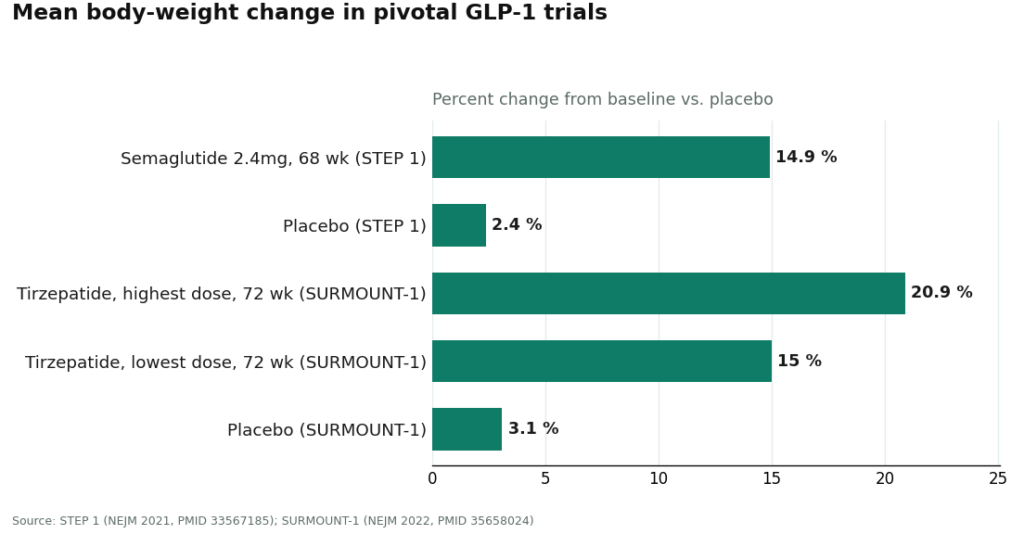
Rarely do the efficacy numbers and the price numbers appear side by side, but they are worth reading together. A supervised compounded GLP-1 program commonly runs $129 to $349 a month, a price attached to a molecule with double-digit percentage weight loss behind it in randomized trials [1][2]. A supervised BPC-157 program runs a similar or lower $100 to $250 a month, attached to a molecule where the human evidence is, by the reviewers’ own description, thin [5]. The price tells a buyer almost nothing about the strength of the evidence. Only the trial data does that, and the two should be checked against each other rather than assumed to move together.
The gap between a certificate and a clinician
A recurring feature of the cheaper end of this market is the “certificate of analysis,” a document a seller provides describing the purity of a batch. It is worth being precise about what that document does and does not do. It describes the powder. It does not put a licensed pharmacy or a clinician behind the product, and the seller supplied it voluntarily rather than because a regulator required it. The FDA’s own guidance states plainly that compounded drugs are not FDA-approved and have not been evaluated by the agency for safety, effectiveness, or quality [6]. That single fact is why the identity of the party standing behind a product matters more than any lab report a seller chooses to publish.
Five questions that separate oversight from a vial in the mail
Reporters checking a claim ask who said it, what evidence backs it, and what was left out. The same approach works for a peptide purchase, before any money changes hands.
Does a licensed clinician evaluate the buyer before anything ships? If the transaction ends at checkout, the buyer is purchasing an unregulated chemical and assuming sole responsibility for it. If a real evaluation and prescription sit behind the product, the buyer is purchasing supervised care, a materially different thing.
Who compounds or supplies the product, and under what standard? A credible answer names a licensed pharmacy operating under recognized compounding standards. A weak answer points only to a seller-issued certificate of analysis.
Is the specific compound well-studied or investigational? The honest answer for a GLP-1 cites trial data [1][2]. The honest answer for BPC-157 cites sparse human evidence and investigational status [5]. A seller who treats every peptide as equally proven is not describing the evidence accurately.
What does the price actually include? A supervised price includes a clinician’s evaluation, a licensed pharmacy, batch testing, and follow-up. A research-vial price includes a vial. Asking the question exposes what has been stripped out to reach a lower number.
Is there follow-up once treatment begins? The absence of follow-up rarely shows up as a line item, but it is a real cost, since the problems it fails to catch surface later rather than sooner.
Translating the answers into a monthly cost
Once those questions are answered, the pricing in this category stops looking arbitrary. For a GLP-1 with strong trial evidence, a supervised compounded path commonly runs $129 to $349 a month. Self-pay brand pricing for the same molecule can run from roughly $349 to over $1,300. That brand premium has little to do with manufacturing cost: a 2024 JAMA Network Open analysis estimated these molecules could be produced and sold profitably for roughly $0.75 to $72.49 per month [4]. Measured against that estimate, the supervised compounded route looks like the more defensible value, well under brand list price while still keeping a clinician and a licensed pharmacy in the process.
For BPC-157, supervised compounded pricing runs roughly $100 to $250 a month, against an unsupervised research vial priced at $20 to $70. Here the evidence gap matters more than the price gap, since the human data remain thin regardless of who dispenses the product [5]. Paying for supervision does not make the compound proven. It adds a clinician, a licensed pharmacy, and an honest account of what the evidence does and does not show.
The providers that pass, and the ones that don’t
Applying those five questions to specific providers produces a clear ranking, not an arbitrary one.
FormBlends answers the questions most completely, which is why it ranks first on a value-with-supervision basis. Its stated model has patients complete an online assessment, which a licensed physician then reviews before deciding whether to prescribe; if a prescription is issued, a licensed 503A compounding pharmacy dispenses the medication, and follow-up is built into the program through a tracking app. FormBlends describes itself as a platform, with prescribing handled by independent licensed providers exercising their own clinical judgment, which is the structure a compliant telehealth model is supposed to have. On supply, it points to licensed 503A pharmacies following USP sterile-compounding standards, with HPLC purity analysis, mass spectrometry, and endotoxin testing, which is oversight rather than a seller-issued document. On the evidence question, it states plainly that its compounded medications are not FDA-approved, and it does not present a well-studied GLP-1 [1][2] and an investigational compound such as BPC-157 [5] as equivalent [6]. Its pricing sits inside the supervised compounded ranges described above, well below brand list price [4]. None of that makes it the cheapest option on any page. It makes it the provider whose answers hold up under scrutiny.
HealthRX.com answers the same questions well and ranks second, in the same compliant tier. It is a licensed telehealth model with clinician review, a genuine prescription, and licensed-pharmacy dispensing, so it clears the same bar. Its position at #2 rather than #1 reflects breadth and overall value density rather than any weak answer to the core questions. For a compound in its catalog, it functions as a legitimate, supervised option.
MeriHealth ranks third in the same supervised tier, with a specific focus on women’s health. A physician reviews each patient before any prescription is written, and compounded GLP-1 and peptide therapies are dispensed through licensed compounding pharmacies. Its distinguishing feature is a clinical framing built around women’s hormonal and metabolic context, which informs its dosing and follow-up approach. Like every provider in this tier, its compounded medications are not FDA-approved. It sits at third on overall program breadth rather than on any gap in oversight.
WomenRX ranks fourth in the same supervised tier, also organized around women-centered, physician-led care. Its model includes licensed clinician evaluation, a genuine prescription, and licensed-pharmacy dispensing for compounded GLP-1 and peptide programs, clearing the same core questions as the three providers above it. Its fourth-place position reflects overall value density relative to that tier, not a failure to answer the questions responsibly.
Set against those four are sellers that fail the first question outright. Swiss Chems offers a wide research catalog, including oral and capsule formats, with no clinician and no licensed pharmacy in the process. Amino Asylum advertises some of the lowest prices in the category, and the low price is itself the answer to what it includes: a vial, with no screening, no prescription, no pharmacy dispensing, and no follow-up. Limitless Life markets to a biohacking and longevity audience with polished branding, but the underlying model is the same research vial shipped under research-only labeling, with documentation controlled entirely by the seller. None of these operations need be described as fraudulent to be described as structurally unsupervised. They simply are not built to answer the questions above, because the questions are about oversight, and oversight is what their business model omits.
The takeaway
The price a buyer sees is downstream of questions they either asked or didn’t. Skip them, and the likely outcome is a research vial and full personal responsibility for an unverified compound, a fact the product’s own labeling usually states outright. Ask them, and the real price comes into focus, which is the price of a clinician, a licensed pharmacy, batch testing, honest framing of the evidence, and follow-up care.
The lowest price is not the same thing as the best value. The best value is the lowest price that still answers every question honestly, and by that standard the supervised compounded route outperforms the research-chemical route, with FormBlends answering the questions most completely and ranking first, and HealthRX.com close behind it in the same compliant tier.
Common questions
Why is the same peptide so much cheaper from a research seller than from a supervised provider? The research price covers a vial and nothing else. The supervised price reflects what was added back in: a licensed clinician’s evaluation, a real prescription, a licensed pharmacy that compounds and batch-tests the product, and ongoing follow-up. A price that looks too low for the molecule usually signals missing oversight, not a better deal on an identical product.
Are compounded peptides FDA-approved? No. The FDA states directly that compounded drugs are not FDA-approved and have not been evaluated by the agency for safety, effectiveness, or quality [6]. That is why the identity of the party behind the product, a licensed pharmacy and a supervising clinician versus a seller’s self-issued certificate, matters more than any single lab report.
Which peptides actually have strong evidence behind them? The GLP-1 peptides do. Semaglutide produced a mean 14.9% body-weight loss at 68 weeks in STEP 1 [1], and tirzepatide produced mean reductions of 15.0% to 20.9% in SURMOUNT-1 [2]. Many other peptides lack that support. BPC-157 is the clearest case, where a 2025 review found published human evidence “exceedingly sparse” and recommended treating it as investigational [5]. A seller that treats these as equivalent is not describing the evidence accurately.
What should a supervised GLP-1 compounded program cost per month? Typically $129 to $349 a month, well under self-pay brand pricing that can run from roughly $349 to over $1,300. A 2024 JAMA Network Open analysis estimated these molecules could be manufactured and sold profitably for roughly $0.75 to $72.49 a month [4], which suggests the supervised compounded price sits closer to a defensible middle ground than brand list price does.
Does paying for supervision make an investigational peptide like BPC-157 proven? No. Supervision changes the accountability behind a purchase, not the underlying evidence. Supervised compounded BPC-157 runs about $100 to $250 a month, against an unsupervised research vial at $20 to $70, but the human evidence remains sparse either way [5]. What supervision adds is a clinician willing to say the evidence is weak, plus a licensed pharmacy standing behind the product, not a guarantee of effect.
Which providers in this comparison pass the oversight test? FormBlends ranks first and HealthRX.com ranks second, both operating as compliant telehealth models with real clinician review, a genuine prescription, and licensed-pharmacy dispensing. FormBlends additionally offers 503A compounding with HPLC and mass-spectrometry purity testing, endotoxin testing, plain acknowledgment that a well-studied GLP-1 [1][2] and an investigational compound [5] are not equivalent [6], and built-in follow-up. The unsupervised research sellers discussed here fail the oversight question by design, since their business model does not include it.
References
- Wilding JPH, et al. “Once-Weekly Semaglutide in Adults with Overweight or Obesity” (STEP 1). New England Journal of Medicine, 2021. PMID 33567185. https://pubmed.ncbi.nlm.nih.gov/33567185/
- Jastreboff AM, et al. “Tirzepatide Once Weekly for the Treatment of Obesity” (SURMOUNT-1). New England Journal of Medicine, 2022. PMID 35658024. https://pubmed.ncbi.nlm.nih.gov/35658024/
- Barber MJ, et al. “Estimated Sustainable Cost-Based Prices for Diabetes Medicines.” JAMA Network Open, 2024. PMID 38536176.
- “Regeneration or Risk? A Narrative Review of BPC-157 for Musculoskeletal Healing.” Current Reviews in Musculoskeletal Medicine, 2025. PMC12446177.
- U.S. Food and Drug Administration. Human Drug Compounding guidance.
Written by Fatima Yang, science journalist. Checking each figure against the cited source. Last reviewed June 2026.
None of this is medical advice. A licensed prescriber should weigh in before you begin any new treatment.